The Deep-Sea Podcast
A couple of deep-sea scientists talk everything deep sea! Interesting facts, recent news, myth-busting and interviews with the most interesting people we know.







Episodes
Mar 2, 2024
Mar 2, 2024
52 min
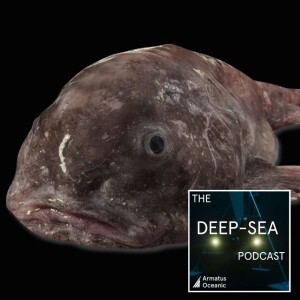
Are you looking for a podcast episode that contains the return of the blobfish, golden crochet hooks and rare deep-sea squid? Well, look no further than this episode of The Deep-Sea Podcast!
It finally happened… we brought you an episode which was recorded almost completely offshore. With Dr Thom in the Bounty Trough and the Professor somewhere in the Pacific, this episode is quite the wild card. Whilst Thom has been busy crocheting fishing nets (that’s science folks), Alan was left to take the reins and he decided to go a little off-piste. We bring it back to the good old days with one of Alan’s (in)famous rants. This one is titled: When does the sea become the deep sea, and why it needs to be changed. Expect to hear about the history of why we decided what makes the deep-sea ‘deep’, and why it might not make sense anymore in our modern world. We’d love to hear your thoughts on this and whether you agree with Alan.
Dr Thom does make an appearance in this episode, giving us a run-down of how the research cruise is going (SPOILER: The blobfish is back). Plus, we hear about the original blobfish and how exactly it came to be an internet sensation, from the man who was there: new fan favourite, Andrew Stewart.
Finally, we check in with a key individual in the online deep-sea community space: Jeff Day. Jeff’s been on our radar for years with his immense knowledge of deep-sea cephalopods and we thought we’d finally hand him the mic. He talks to us all about his love of deep sea creatures and how he contributes to the field in unconventional ways.
We’re really trying to make this project self-sustaining so we have started looking for ways to support the podcast. Here’s a link to our page on how to support us, from the free options to becoming a patron of the show. We want to say a huge thank you to those patrons who have already pledged to support us:
Jacqueline | Tyler Medeiros | Kevin Gilley
Thanks again for tuning in, we’ll deep-see you next time!
Check out our podcast merch here! Which now includes Alan’s beloved apron and a much anticipated new design...
Feel free to get in touch with us with questions or your own tales from the high seas on:
podcast@armatusoceanic.com
We’d love to actually play your voice so feel free to record a short audio note!
We are also on
Twitter: @DeepSeaPod, @ArmatusO
Facebook: DeepSeaPodcast, ArmatusOceanic
Instagram: @deepsea_podcast, @armatusoceanic
Keep up with the team on social media
Twitter:
Alan - @Hadalbloke (https://twitter.com/Hadalbloke)
Thom - @ThomLinley (https://twitter.com/ThomLinley)
Georgia - @geeinthesea (https://twitter.com/geeinthesea)
Instagram:
Georgia - @geeinthesea (https://www.instagram.com/geeinthesea/)
Read the show notes and find out more about us at:
www.armatusoceanic.com
Links
Moku Art Studio virtual exhibition
Parasite director Bong Joon-ho is set to begin filming deep sea species for his new film this year
A new species of deep-sea mud dragon has been described by Martin Vinther Sørensen
New fishery for lanternfish https://phys.org/news/2024-02-deep-sea-fishery-horizon.html
Info on the original Mr Blobby
People mentioned:
Follow Jeff on twitter
More info about Andrew Stewart
Dr Vincent Zintzen (Filmed the blobfish in situ)
Dr Derek Hennen (millipede and centipede taxonomist)
The Magnapinna Archive (Youtube and Twitter)
Bruce Robison
Daniel Moore - Ocean census
Kat Bolstead (ALCES Squid Squad)
Kerryn Parkinson (Australian Museum)
Joe Nelson (Expert in blobfishes)
Soundtrack of the month:
Tangaroa - Alien Weaponry
Spotify & Youtube
Credits
Theme – Hadal Zone Express by Märvel
Logo image - Thomas Linley
Edited by - Georgia Wells
Feb 24, 2024
Feb 24, 2024
25 min
Our short and to the point PRESSURISED version of episode 19. If you don't have time for the full episode and want to get right to the science without any of our waffle, this is the place to be! Read the show notes and find the full episode here: https://www.armatusoceanic.com/podcast/019-squid
As promised in the Christmas special, we call the ‘squid-phone’ – a special line used by scientists globally when they seem something strange and squiddy. On the other end of that line is Mike Vecchione, the expert on cephalopods. We talk giant and colossal squid (to audible groans from Mike); the bigfin squid (Magnapinna), most famous for being the squid with the long trailing arms that’s often used as an example of terrifying deep-sea creatures, but also a species, genus and Family that Mike described and would love more sightings of.
We are also on:
Twitter: @DeepSeaPod
Facebook: @DeepSeaPodcast
Instagram: @deepsea_podcast
Read the show notes and find out more about us at: www.armatusoceanic.com
Credits Theme – Hadal Zone Express by Märvel
Edited by - Georgia Wells
#deepsea #marinebiologist #marinebiology #podcast #marianatrench #science #magnapinna #colossalsquid #giantsquid #gigantism #scicomm #deepseafish #deepseacreatures
Feb 10, 2024
Feb 10, 2024
27 min
Our short and to the point PRESSURISED version of episode 43. If you don't have time for the full episode and want to get right to the science without any of our waffle, this is the place to be!
Read the show notes and find the full episode here:
https://www.armatusoceanic.com/podcast/043-offshore-stories
From being repeatedly thrown off your bed in a storm, to seeing blue whales out of your porthole, working at sea doesn't leave you short of stories. And with Dr Thom and the Professor both heading offshore soon, they thought what better time to share some of their sea stories. From tips on how to hold your pee for 12+ hours, to tales of typhoons, this episode is jam-packed with real-life tales from decades of working offshore.
We’re really trying to make this project self-sustaining so we have started looking for ways to support the podcast. Here’s a link to our page on how to support us, from the free options to becoming a patron of the show. We want to say a huge thank you to those patrons who have already pledged to support us:
Antony Raymont | Courtney Johnston | Davina Gifford | Sophie Schindler
Thanks again for tuning in, we’ll deep-see you next time!
DID YOU KNOW WE SELL MERCH?
Check it out here!! And please do send in any pics of you wearing the merch!
Feel free to get in touch with us with questions or your own comments on:
podcast@armatusoceanic.com
We’d love to actually play your voice so feel free to record a short audio note!
Follow us on social media!
Twitter: @DeepSeaPod, @ArmatusO
Facebook:DeepSeaPodcast, ArmatusOceanic
Instagram: @deepsea_podcast, @armatusoceanic
Keep up with the team on social media:
Twitter: Alan - @Hadalbloke, Thom - @ThomLinley, Georgia - @geeinthesea
Instagram: Thom - @Thom.Linley, Georgia - @geeinthesea
Read the show notes and find out more about us at:
www.armatusoceanic.com
Credits
Theme – Hadal Zone Express by Märvel
Logo image - The Deep-Sea Podcast: PRESSURISED Logo
Edited by - Georgia Wells
Feb 3, 2024
Feb 3, 2024
53 min
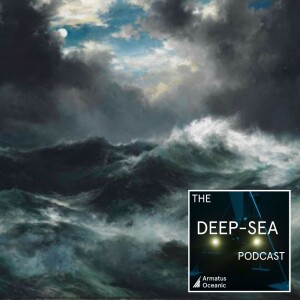
From being repeatedly thrown off your bed in a storm, to seeing blue whales out of your porthole, working at sea doesn't leave you short of stories. And with Dr Thom and the Professor both heading offshore soon, they thought what better time to share some of their sea stories. From tips on how to hold your pee for 12+ hours, to tales of typhoons, this episode is jam-packed with real-life tales from decades of working offshore.
In deep sea news: Norway has decided to go ahead with deep sea mining, cold coral reefs are being discovered, and hoards of marine fungi have been found in the twilight zone! But more importantly than all of that: the Professor was awarded an OBE! His sword and noble steed are currently in the post (first class), and we’re hoping they reach him in Perth from the Palace.
We’ve also started a new segment with long-time friend of the show, Andrew Stewart who has an interesting hobby of manufacturing cod-liver shark-liver oil. Expect more unexpected stories from Andrew in future episodes!
Finally, we want to say thanks again for your support! We have lots of exciting upcoming episodes all about the (in)famous hagfish, deep sea sharks and our favourite: chimera. Stay tuned!
We’re really trying to make this project self-sustaining so we have started looking for ways to support the podcast. Here’s a link to our page on how to support us, from the free options to becoming a patron of the show. We want to say a huge thank you to those patrons who have already pledged to support us:
Antony Raymont | Courtney Johnston | Davina Gifford | Sophie Schindler
Thanks again for tuning in, we’ll deep-see you next time!
DID YOU KNOW WE SELL MERCH?
Check it out here!! And please do send in any pics of you wearing the merch!
Feel free to get in touch with us with questions or your own comments on:
podcast@armatusoceanic.com
We’d love to actually play your voice so feel free to record a short audio note!
Follow us on social media!
Twitter: @DeepSeaPod, @ArmatusO
Facebook:DeepSeaPodcast, ArmatusOceanic
Instagram: @deepsea_podcast, @armatusoceanic
Keep up with the team on social media:
Twitter: Alan - @Hadalbloke, Thom - @ThomLinley, Georgia - @geeinthesea
Instagram: Thom - @Thom.Linley, Georgia - @geeinthesea
Read the show notes and find out more about us at:
www.armatusoceanic.com
Further resources
Just the Zoo of us Podcast with Dr Thom
DOSI newsletter to keep up with everything deep sea
News
Megalodon tooth found in nodule field
Norway becomes the first country in the world to approve commercial-scale deep-sea mining.
Largest study of ocean dna finds a huge abundance of fungi in the mesopelagic zone. Scientific paper & news article
Hagfish genome sequenced
Largest cold-water coral reef to date has been found
Guest info
Andrew’s bio
Andrew’s blog on the Gut Stuffer 2000
Soundtrack of the month
A Song About an Anglerfish - Hank Green
Glossary
Cold-water corals - Deep-water corals (or cold-water corals) grow in water temperatures of 4 - 12°C. Unlike shallow water corals, they do not depend on a symbiotic algae (zooxanthellae) for growth and survival, resulting in slower growth.
Deep-sea mining - The process of extracting manganese nodules from the deep ocean floor.
Hagfish - An eel-shaped jawless fish. Hagfish are marine predators and scavengers.
Hull - A hull is the watertight body of a ship.
Megalodon - An extinct species of giant shark that lived approximately 23 to 3.6 million years ago.
Metagenomes - Genetic material taken from the environment rather than from one individual.
OBE - (Order of the British Empire) is a British award rewarding contributions to the arts and sciences, work with charitable and welfare organisations, and public service outside the civil service.
Squalene - Squalene is a natural oil that comes from shark liver.
Submarine - A submarine (or sub) is a watercraft capable of independent operation underwater.
Thrusters - Manoeuvering thrusters (bow thrusters and stern thrusters) are propulsion devices built into, or mounted to, either the bow or stern, of a ship to make it more manoeuvrable.
Credits
Theme – Hadal Zone Express by Märvel
Logo image - Wikicommons
Edited by - Georgia Wells
Jan 27, 2024
Jan 27, 2024
26 min
Our short and to the point PRESSURISED version of episode 18. If you don't have time for the full episode and want to get right to the science without any of our waffle, this is the place to be!
Read the show notes and find the full episode here:
https://www.armatusoceanic.com/podcast/018-sound
We think of the deep sea as an eerily quiet and spooky place but that isn’t completely true, animal communication, seismic activity, human noise and even the sound of rain and waves from 10 km above. We chat with undersea audio expert Dr David Barclay about the fascinating audio properties of the deep ocean. As we are talking audio data on an audio medium, lets have some fun with a game of ‘what can we grenad-hear’ where Thom tries to guess the deep-sea sound.
Feel free to get in touch with us with questions or you own tales from the high seas on:
podcast@armatusoceanic.com
Support the show here: https://patreon.com/deepseapodcast
We are also on:
Twitter: @DeepSeaPod, @ArmatusO
Facebook: DeepSeaPodcast, ArmatusOceanic
Instagram: @deepsea_podcast, @armatusoceanic
Keep up with the team on social media
Twitter:
Alan - @Hadalbloke
Thom - @ThomLinley
Georgia - @geeinthesea
Instagram:
Thom - @ThomLinley
Georgia - @geeinthesea
Read the show notes and find out more about us at:
www.armatusoceanic.com
Glossary
CTD: Conductivity, temperature and depth sensor
Gametes: sex or germ cells. Eggs and sperm
Grenadier: another name for a rattail fish
Hydrothermal vent: seawater heated by the earth flows out of the seabed
Lander: Free-falling or pop-up vehicle. Sinks from the surface and comes up again by dropping ballast
Refraction: the change in direction of a wave passing from one medium to another
Sound channel: Also called the SOFAR channel, a horizontal layer of water in the ocean at which depth the speed of sound is at its minimum
Links
David’s other podcast: Sciographie
David’s research website
Implosion in the Challenger Deep paper
Underwater noise during COVID-19:
Credits
Theme – Hadal Zone Express by Märvel
Logo image - The Deep-Sea Podcast PRESSURISED Logo
Jan 6, 2024
Jan 6, 2024
1 hr 25 min
THE DECO-STOP: A DEEPER LOOK INTO THE HUMANS BEHIND DEEP SEA SCIENCE AND TECHNOLOGY.
This is our third Deco-Stop episode, and this time we’re focusing on eco-anxiety. We are currently in the midst of an ecological crisis, but eco-anxiety is something of a mental health crisis in response. Many of us who work in this space (and many of us who don’t) are feeling these emotions, including plenty of our listeners who have got in touch to share their experiences. As such, we’ve wanted to make this episode for some time, but during it’s production, it became a far bigger subject than we were ready for. One thing that did become apparent, is that this is a dangerous subject and it is something that can do real harm. In this episode, we share with you some stories of how different individuals have influenced their lives in a direct response to eco-anxiety. Plus, we hear from the perspective of a psychotherapist who specialises in the field of climate & eco-crisis psychology. However, this is not a list of answers, and the priority is your health and safety and as the listener.
We hope that this episode offers an insight towards such a big and difficult topic. Whilst it won’t leave you with a complete set of instructions on how to fix the world, we hope you find it comforting that there is a huge number of people who are feeling the same as you are. It’s a lrngthy one, so grab a cup of tea, give your local tree a quick hug, and tune in to this beefy episode of the Deco-Stop.
MEET OUR GUESTS
CAROLINE HICKMAN
Psychotherapist and lecturer at the University of Bath working in the field of climate psychology. Her research focuses on eco-anxiety, distress about the climate and ecological crisis in children and young people.
LEARN MORE
DAN DE KLERK
Co-founder of Nomadic Permaculture, an organisation based in Picton, New Zealand that offers consultancy and courses in how to live a more sustainable lifestyle in harmony with your local community and ecosystem.
LEARN MORE
BRIAN BERNEMAN
Wellness coach and co-founder of Conscious Action, a collective based in Auckland, New Zealand that encourages people to make meaningful and achievable changes in their lives, to help the planet.
LEARN MORE
DID YOU KNOW WE SELL MERCH?
Check it out here!! And please do send in any pics of you wearing the merch!
Feel free to get in touch with us with questions or your own comments on:
podcast@armatusoceanic.com
We’d love to actually play your voice so feel free to record a short audio note!
FOLLOW US ON SOCIAL MEDIA!
Twitter: @DeepSeaPod, @ArmatusO
Facebook:DeepSeaPodcast, ArmatusOceanic
Instagram: @deepsea_podcast, @armatusoceanic
Keep up with the team on social media
Twitter: Alan - @Hadalbloke, Thom - @ThomLinley, Georgia - @geeinthesea
Instagram: Georgia - @geeinthesea
LINKS
RESOURCES
MENTIONED BY DAN
Dan’s Nomadic Permaculture course on sustainable food growing
Info on the Kaipātiki Project (which Dan also works for) and his Sustainable Life: Design Workshop
MENTIONED BY CAROLINE
Sally Weintrobe - Psychoanalyst who focuses on climate anxiety and it’s links to neoliberal capitalism and the culture of ‘un-care’
Jay Griffiths - Author who writes about how western children have more mental health issues than children from indigenous cultures
Paul Hoggett - Co-founder of the Climate Psychology Alliance and coined the term ‘love miles’
Every other day a climate activist is murdered - news article
Climate Psychology Alliance Therapeutic Support
Climate Psychology Alliance Climate Cafes
CREDITS
Theme – Hometime by Harvey Jones
Logo image - The Deco-Stop
Dec 23, 2023
Dec 23, 2023
29 min
Our short and to the point PRESSURISED version of episode 17. If you don't have time for the full episode and want to get right to the science without any of our waffle, this is the place to be!
Read the show notes and find the full episode here:
https://www.armatusoceanic.com/podcast/017-going-to-sea
We love going to sea, it is probably the best part of the job. That’s where most of our adventures happen, that’s where most of the exciting discoveries and firsts happen and it’s where we meet some of the most interesting people. We want you to have a great time at sea too and not be put off by a bad first experience. Poor packing or a faux pas could spoil the whole experience and we don’t want that. We put together some advice for your first trip. Forgive us if parts seem patronising, they are all things we have seen spoil someone’s trip and with everything else to worry about, it’s easy to forget the simple stuff.
We chat with Larkin, a deck-hand turned youtuber about life at sea and sharing that experience through her videos. What is her average day like at sea and how’s the morning commute when your office is a small response vessel chasing a submarine 10,000 m below you? How can you get a celebratory tattoo offshore from an unqualified scientist? “Don’t worry, he’s a doctor, not that sort of doctor but don’t worry about that!”
Feel free to get in touch with us with questions or you own tales from the high seas on:
podcast@armatusoceanic.com
We are also on
Twitter: @ArmatusO
Facebook: ArmatusOceanic
Instagram: @armatusoceanic
Read the show notes and find out more about us at:
www.armatusoceanic.com
Glossary
AB – Able Bodied seamen or deck hands
A-frame – type of lifting equipment, usually at the stern
Aft – towards the front of the boat
Bow – the front of the boat
Bridge – Usually at the top of the boat, where it is steered from
Bulkhead – the thick metal internal walls of a boat
Cabin – where you sleep offshore
Deck – the floors on a boat
Fore – towards the front of the boat
Head – the toilet
Mates – Officers under the captain (1st and 2nd mate)
Mess – the dining hall on a boat
Port – left side of the boat (regardless of which way you are facing), colour coded red
Rigger boots – steel toe capped safety shoes
Starboard - right side of the boat (regardless of which way you are facing), colour coded green
Zodiac – a small and fast inflatable boat
My Salty Sea Life
Website
Instagram
YouTube
Facebook
Larkin’s ‘a day in the life of a sailor’ video. Great prep for your first time at sea.
Larkin’s morning commute
(a keen eye may spot Alan pottering about in the background)
Credits
Theme – Hadal Zone Express by Märvel
Logo image - The Deep-Sea Podcast PRESSURISED
Dec 2, 2023
Dec 2, 2023
27 min
"Exploration is curiosity acted upon." — Don Walsh
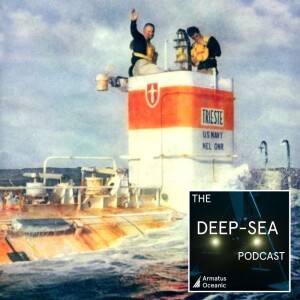
In this month’s episode, we’re honouring the late great Don Walsh, who sadly left us this month. You may have noticed that we hadn’t heard from Don in a good few months. He had a couple of ops that required some getting over, but that wasn’t going to slow him down. In September he was going through the Northwest Passage, a trip he had attempted 2 previous times but had been scuppered by weather and vessel trouble. Don’s unwavering commitment to deep-sea exploration meant that the monthly sea stories were no longer possible but we weren’t going to let the legendary Don Walsh sneak off without some fanfare, not after everything he’s done for us.
We were putting together a Christmas episode where we could share some drinks and stories with Don and give him a proper send-off. While we were sorting out dates that everyone could do, Don passed. 92, nodding off in his favourite chair at the remote home he loved, surrounded by nature.
Over the last 3 years it’s been a privilege to have Don recount one of his endless list of stories with us every month, stories that always made us smile. In some attempt to raise a toast to him and all that he’s done for the community, we bring you this Don Special episode. He will be missed.
Legend.
Thanks again for tuning in, we’ll deep-see you next time!
Feel free to get in touch with us with questions or your own comments on:
podcast@armatusoceanic.com
We’d love to actually play your voice so feel free to record a short audio note!
We are also on:
Twitter: @DeepSeaPod, @ArmatusO
Facebook: DeepSeaPodcast, ArmatusOceanic
Instagram: @deepsea_podcast, @armatusoceanic
Keep up with the team on social media
Twitter:
Alan - @Hadalbloke
Thom - @ThomLinley
Georgia - @geeinthesea
Instagram:
Thom - @ThomLinley
Georgia - @geeinthesea
Read the show notes and find out more about us at:
www.armatusoceanic.com
Credits
Theme – Hadal Zone Express by Märvel
Logo image - Life Magazine 1960 Edition
Nov 25, 2023
Nov 25, 2023
29 min
Our short and to the point PRESSURISED version of episode 16. If you don't have time for the full episode and want to get right to the science without any of our waffle, this is the place to be!
Read the show notes and find the full episode here:
https://www.armatusoceanic.com/podcast/016-biodiscovery
We are in desperate need for new bioactive compounds. Super bugs are on the rise as evolution finds a way of thwarting our antibiotics. We are also continually on the hunt for compounds that can fight disease, ease suffering or get your teeth super white. The natural world has been experimenting for millions of years and has come up with solutions far more elegant than we could come up with.
The ocean, and in particular the deep ocean, may be the best place to look for new compounds but is this a threat to the ocean? It is often mentioned alongside seabed trawling, climate change and mining as a threat to the deep ocean. Should we call it bioprospecting or biodiscovery and what’s the difference? If most of the world’s ocean belongs to everyone, who owns a discovery? How do we ensure that developed nations, who are better equipped to benefit from a discovery, don’t leave developing nations out? Are companies really patenting naturally occurring compounds? If we find something exciting, what is the process for it becoming the next wonder drug?
While they both agree that looking for new compounds in the deep sea sounds good, Alan and Thom are soon stumped by the complexities of actually making that happen in a fair and sustainable way. Luckily, they can call on Professor Marcel Jaspars, head of the Marine Biodiscovery Centre to help us through the practicalities of biodiscovery but also its political and ethical complexities.
Feel free to get in touch with questions or you own tales from the high seas on:
podcast@armatusoceanic.com
We are also on
Twitter: @ArmatusO
Facebook: ArmatusOceanic
Instagram: @armatusoceanic
Read the show notes and find out more about us at:
www.armatusoceanic.com
Links
United Nations Convention on the Law of the Sea
The Convention on Biological Diversity
The Nagoya Protocol
The Deepest of Ironies (paywall)
Evolving Perspectives On The International Seabed Area’s Genetic Resources: Fifteen Years After The ‘Deepest Of Ironies’ (paywall)
Who owns marine biodiversity? Contesting the world order through the ‘common heritage of humankind’ principle
Corporate control and global governance of marine genetic resources
Polymers: Secrets from the deep sea
Ocean Biodiversity Information System (OBIS)
Ocean Tool for Public Understanding and Science (OcToPUS)
Song of the Ocean – Global Virtual Performance 2021
Sharing the Benefits of the Ocean (loads of wider reading here)
Glossary
Benthopelagic - Living and feeding near the bottom as well as in midwaters or near the surface but also the depth zone about 100 metres off the bottom at all depths below the edge of the continental shelf.
Endothermy – Animals that regulate their body temperature (we used to call this ‘warm blooded’)
Geomagnetic – The Earth’s magnetic field e.g., magnetic north.
Mantle – The muscular tube that makes up a squids body.
Mesopelagic – Open water fish between about 200 and 1,000 metres (approximately 650 and 3,300 ft) down.
SoFAR channel - sound fixing and ranging channel. The SOFAR channel acts as a waveguide for sound, and low frequency sound waves within the channel may travel thousands of miles before dissipating.
Vertical migration – Every night, mesopelagic fish come shallower to feed. This is the largest migration on Earth and it happens every day.
Credits
Theme – Hadal Zone Express by Märvel
Nov 11, 2023
Nov 11, 2023
29 min
Our short and to the point PRESSURISED version of episode 41. If you don't have time for the full episode and want to get right to the science without any of our waffle, this is the place to be!
Read the show notes and find the full episode here:
https://www.armatusoceanic.com/podcast/041-whales
We all know that Thom and Alan aren’t the biggest fans of ‘air-breathers’ aka. marine mammals like dolphins and whales, but there are a few species that are allowed into the deep-sea club. We hear from Dr Nicola Quick who researches the incredibly elusive beaked whales, a group that likely spends the majority of their time in the deep sea. These interesting whales have been seen diving to depths of 3000 m, which way exceeds the max depth of their more famous cousin, the sperm whale (who usually hang out at around 1500m deep).
We’re really trying to make this project self-sustaining so we have started looking for ways to support the podcast. Here’s a link to our page on how to support us, from the free options to becoming a patron of the show.
Thanks again for tuning in, we’ll deep-see you next time!
Check out our podcast merch here! Which now includes Alan’s beloved apron and a much anticipated new design...
Feel free to get in touch with us with questions or your own tales from the high seas on:
podcast@armatusoceanic.com
We’d love to actually play your voice so feel free to record a short audio note!
We are also on:
Twitter: @DeepSeaPod, @ArmatusO
Facebook: DeepSeaPodcast, ArmatusOceanic
Instagram: @deepsea_podcast, @armatusoceanic
Keep up with the team on social media
Twitter:
Alan - @Hadalbloke (https://twitter.com/Hadalbloke)
Thom - @ThomLinley (https://twitter.com/ThomLinley)
Georgia - @geeinthesea (https://twitter.com/geeinthesea)
Instagram:
Georgia - @geeinthesea (https://www.instagram.com/geeinthesea/)
Read the show notes and find out more about us at:
www.armatusoceanic.com
FURTHER RESOURCES
MORE INFORMATION ON NICOLA
https://www.plymouth.ac.uk/staff/nicola-quick
https://scholars.duke.edu/person/nicola.quick/
Nicola’s paper on tagging the deep-diving beaked whales
Nicola’s twitter
Wider reading
Credits
Theme – Hadal Zone Express by Märvel
Logo image - The Deep-Sea Podcast PRESSURISED
GLOSSARY
Bounce dives - A series of shorter, shallower dives for beaked whales in between really big, deep dives to >1500 m
Cetacean - The group name for whales and dolphins
Cuvier's Beaked Whale - One of the most frequently sighted species of beaked whales in the world. They are found in most oceans and seas worldwide and have the most extensive range of all beaked whale species.
Epiglottis - The small, movable "lid" just above the larynx that prevents food and drink from entering the windpipe.
Foraging - A technical term for ‘finding food’.
Mammal - A vertebrate that breathes air, has mammary glands and three inner ear bones.
PAMs (Passive acoustic monitoring) - Surveying and monitoring wildlife and environments using sound recorders (acoustic sensors).
Pod - The term for a group of cetaceans.
VHF antenna - A VHF marine radio antenna is used to transmit and receive VHF marine radio signals enabling communication with other boats, as well as with the shore and other emergency services.
Ziphiidae - The family name for beaked whales.
Nov 4, 2023
Nov 4, 2023
1 hr 14 min
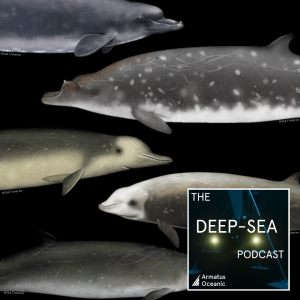
We all know that Thom and Alan aren’t the biggest fans of ‘air-breathers’ aka. marine mammals like dolphins and whales, but there are a few species that are allowed into the deep-sea club. We hear from Dr Nicola Quick who researches the incredibly elusive beaked whales, a group that likely spends the majority of their time in the deep sea. These interesting whales have been seen diving to depths of 3000 m, which way exceeds the max depth of their more famous cousin, the sperm whale (who usually hang out at around 1500m deep).
It also turns out that we as humans have something in common with these deep diving critters: the mammalian dive response. We hear from Dr Ryan ‘Beefy’ Beecroft, a sub engineer and keen free-diver, who explains to us what deep diving feels like when you are an air breather.
What’s more, the Professor tells the story about the infamous Goblet of Hades. If you manage to see this little piece of history in the background of documentaries, please do send a pic in!
We’re really trying to make this project self-sustaining so we have started looking for ways to support the podcast. Here’s a link to our page on how to support us, from the free options to becoming a patron of the show. We want to say a huge thank you to those patrons who have already pledged to support us:
Andy Koenig | Trace Ritchey | Harley Pollitt | Alice
Thanks again for tuning in, we’ll deep-see you next time!
Check out our podcast merch here! Which now includes Alan’s beloved apron and a much anticipated new design...
Feel free to get in touch with us with questions or your own tales from the high seas on:
podcast@armatusoceanic.com
We’d love to actually play your voice so feel free to record a short audio note!
We are also on:
Twitter: @DeepSeaPod, @ArmatusO
Facebook: DeepSeaPodcast, ArmatusOceanic
Instagram: @deepsea_podcast, @armatusoceanic
Keep up with the team on social media
Twitter:
Alan - @Hadalbloke (https://twitter.com/Hadalbloke)
Thom - @ThomLinley (https://twitter.com/ThomLinley)
Georgia - @geeinthesea (https://twitter.com/geeinthesea)
Instagram:
Georgia - @geeinthesea (https://www.instagram.com/geeinthesea/)
Read the show notes and find out more about us at:
www.armatusoceanic.com
FURTHER RESOURCES
LINKS
MORE INFORMATION ON NICOLA
https://www.plymouth.ac.uk/staff/nicola-quick
https://scholars.duke.edu/person/nicola.quick/
Nicola’s paper on tagging the deep-diving beaked whales
Nicola’s twitter
Wider reading
NEWS
Andrew’s hadal coffee blog from back in the day
The blue Atacama snailfish has some fanart
The quest for the bibby. It seems to be from a RPG project called Snail Morning about hadal snailfish.Twitter & Blog
Deep-sea neutrino telescope in the Western Pacific
https://www.nature.com/articles/s41550-023-02087-6
https://www.shine.cn/news/metro/2310104693/
Sounds of the deep
Seals To Exploit Sparse Deep-sea Prey
SOUNDTRACK OF THE MONTH:
The Hagfish Incident by Louie Zong
Spotify
Youtube
Context:
The incident it is paying tribute to is when a truck carrying Police in Oregon were in a slimy situation on Thursday after a truck carrying 7,500 pounds of live hagfish failed to stop at a construction site and spilled its contents onto the highway and over surrounding cars.
“As the tanks fall down, slime will coat your Toyota Preus”
News report:
https://youtu.be/ctoBivu2NSE?si=oafVp4RgcWevlWbt
https://www.nationalgeographic.com/animals/article/hagfish-slime-oregon-highway
Credits
Theme – Hadal Zone Express by Märvel
Logo image - NOAA Fisheries
GLOSSARY
Bounce dives - A series of shorter, shallower dives for beaked whales in between really big, deep dives to >1500 m
Cetacean - The group name for whales and dolphins
Cuvier's Beaked Whale - One of the most frequently sighted species of beaked whales in the world. They are found in most oceans and seas worldwide and have the most extensive range of all beaked whale species.
Epiglottis - The small, movable "lid" just above the larynx that prevents food and drink from entering the windpipe.
Foraging - A technical term for ‘finding food’.
Mammal - A vertebrate that breathes air, has mammary glands and three inner ear bones.
PAMs (Passive acoustic monitoring) - Surveying and monitoring wildlife and environments using sound recorders (acoustic sensors).
Pod - The term for a group of cetaceans.
VHF antenna - A VHF marine radio antenna is used to transmit and receive VHF marine radio signals enabling communication with other boats, as well as with the shore and other emergency services.
Ziphiidae - The family name for beaked whales.
Oct 28, 2023
Oct 28, 2023
29 min
Our short and to the point PRESSURISED version of episode 15. If you don't have time for the full episode and want to get right to the science without any of our waffle, this is the place to be!
Read the show notes and find the full episode here:
www.armatusoceanic.com/podcast/015-space-pt2
We are still exploring the parallels between space and deep-ocean exploration. It feels like technology and access is really accelerating in both spheres. Don calls in to teach us about the amount of water in our solar system and the potential new job title – Planetary Oceanographer.
When samples or access to a vehicle is limited, how can we ensure that resources are shared fairly? We have seen it lead to disagreements on ships. With something as singular and precious as a Mars rover, how are its objectives planned? Evan Hilgemann, mechanical engineer and Curiosity Rover driver with NASA’s Jet Propulsion Lab (JLP) joins us to share how a rover is managed. We chat about the parallels between exploring mars and exploring the deep sea, the similar issues we face, what we can learn from each other and most excitingly, where is technology heading on both fronts! These are exciting times.
Feel free to get in touch with questions or you own tales from the high seas on:
podcast@armatusoceanic.com
We are also on
Twitter: @ArmatusO
Facebook: ArmatusOceanic
Instagram: @armatusoceanic
Read the show notes and find out more about us at:
www.armatusoceanic.com
Glossary
Autonomous - Something which can get on with things without human control
AUV - Autonomous Underwater Vehicle
Distributed intelligence – a very fuzzy term but basically multiple ‘stupid’ elements working together to do complex processing or make complex decisions.
Hadal - Areas more than 6000 m deep, mainly the deep-ocean trenches
JPL - NASA Jet Propulsion Laboratory
ROV - Remotely Operated Vehicle
Transect - A quantitative survey of an area. You fly a set path and quantify everything on it.
Links
Evan’s Twitter: @evanhilgemann
Evan’s Newsletter
Credits
Theme – Hadal Zone Express by Märvel
Oct 14, 2023
Oct 14, 2023
26 min
Our short and to the point PRESSURISED version of episode 40. If you don't have time for the full episode and want to get right to the science withut any of our waffle, this is the place to be!
Read the show notes and find the full episode here:
www.armatusoceanic.com/podcast/040-canyons
So everyone has been pretty busy but we finally got round to finishing off our deep sea habitats series with this episode on submarine canyons. We talk with Dr Teresa Amaro, from the University of Aveiro in Portugal about these hugely important habitats in the deep sea and how they influence the fauna of the continental shelf.
Thanks again for tuning in, we’ll deep-see you next time!
DID YOU KNOW WE SELL MERCH?
Check it out here!! And please do send in any pics of you wearing the merch!
Feel free to get in touch with us with questions or your own comments on:
podcast@armatusoceanic.com
We’d love to actually play your voice so feel free to record a short audio note!
FOLLOW US ON SOCIAL MEDIA!
Twitter: @DeepSeaPod, @ArmatusO
Facebook:DeepSeaPodcast, ArmatusOceanic
Instagram: @deepsea_podcast, @armatusoceanic
Keep up with the team on social media
Twitter: Alan - @Hadalbloke, Thom - @ThomLinley, Georgia - @geeinthesea
Instagram: Georgia - @geeinthesea
Read the show notes and find out more about us at:
www.armatusoceanic.com
CREDITS
Theme – Hadal Zone Express by Märvel
Oct 7, 2023
Oct 7, 2023
54 min
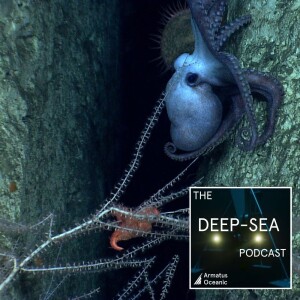
So everyone has been pretty busy but we finally got round to finishing off our deep sea habitats series with this episode on submarine canyons. We talk with Dr Teresa Amaro, from the University of Aveiro in Portugal about these hugely important habitats in the deep sea and how they influence the fauna of the continental shelf. Plus, we get to hear the infamous story of when The Professor and Teresa docked in Lisbon during a cruise and Teresa was able to clear out a bar for the whole of the crew.
Plus, the deep sea has been all over the news this month with lots of new papers being released. Magnetic bacteria have been found by the (phenomenally named) HYPER-DOLHPIN ROV, mysterious markings on the seafloor turn out to be face-planting fish, and scientists have been training jellyfish to navigate through assault courses (kinda).
The Professor’s deep sea research lab have also been busy recently with lots of exciting videos coming out from their landers. Plus, one mystery creature has the whole team stumped. Is it a nudibranch? Or is it something else entirely?
We’re really trying to make this project self-sustaining so we have started looking for ways to support the podcast. Here’s a link to our page on how to support us, from the free options to becoming a patron of the show. We want to say a huge thank you to those patrons who have already pledged to support us:
Julian Moore | Juli Berwald | Karen Pratt | Susan Casey
Thanks again for tuning in, we’ll deep-see you next time!
DID YOU KNOW WE SELL MERCH?
Check it out here!! And please do send in any pics of you wearing the merch!
Feel free to get in touch with us with questions or your own comments on:
podcast@armatusoceanic.com
We’d love to actually play your voice so feel free to record a short audio note!
FOLLOW US ON SOCIAL MEDIA!
Twitter: @DeepSeaPod, @ArmatusO
Facebook:DeepSeaPodcast, ArmatusOceanic
Instagram: @deepsea_podcast, @armatusoceanic
Keep up with the team on social media
Twitter: Alan - @Hadalbloke, Thom - @ThomLinley, Georgia - @geeinthesea
Instagram: Georgia - @geeinthesea
Read the show notes and find out more about us at:
www.armatusoceanic.com
FURTHER RESOURCES
LINKS
Kelp lightbulb art exhibition at Te Papa
Big eye jellyhead spotted on Alan’s landers
Unknown species spotted on Alan’s landers
Fish have been smashing their faces into the seabed for a while
Fossil spines reveal deep sea's past
Revolutionary deep-sea habitat to be available by 2027
Magnetic bacteria in the deep sea
Learning in Jellyfish
DNA found in filter feeding sponges reveals deep-sea fish community
Incise symposium 2023
CREDITS
Theme – Hadal Zone Express by Märvel
Logo image - NOAA
GLOSSARY
Canyon - Narrow steep-sided valleys that cut into continental slopes and continental rises of the oceans.
Cleft - A divide.
Continental shelf - A continental shelf is the edge of a continent that lies under the ocean. It extends from the coastline of a continent to a drop-off point called the shelf break.
Holothurian - A sea cucumber. They feed by ingesting sediment to obtain the nutrients.
Lander - A piece of deep sea equipment which free-falls to the seafloor and collects data via cameras, collection equipment etc.
ROV - Remotely operated vehicle. These are robots, tethered to the surface vessel which are used to explore an area in the deep sea, whilst being operated from the surface.
Sep 30, 2023
Sep 30, 2023
29 min
Our short and to the point PRESSURISED version of episode 14. If you don't have time for the full episode and want to get right to the science without any of our waffle, this is the place to be!
Read the show notes and find the full episode here:
www.armatusoceanic.com/podcast/014-space-pt1
The topic for this double episode is, as ever, the deep sea. But this time we are talking about the deep sea… Innnnnn Spaaaaaaaace! It turns out there is deep sea outside of earth in our solar system in the ice-covered moons of the gas giants. How likely are they to contain deep-sea life completely independent from the life that originated on earth? Thom chats with astrobiologist Kevin Peter Hand, author of Alien Oceans: The search for life in the depths of space, and director of NASA’s Ocean Worlds Lab. What are the best candidates for alien life in our solar system? What could that life be like and why does our own deep ocean provide a perfect test bed?
It turns out that the early versions of the vehicles which may some day explore these ocean worlds are already in development. Thom chats with Casey Machado, Research Engineer at Woods Hole Oceanographic Institution about the Orpheus AUV, the first generation of such vehicle and a new asset to the exploration of our own deep ocean.
Feel free to get in touch with us with questions or your own tales from the high seas on:podcast@armatusoceanic.com
We are also on:Twitter: @ArmatusOFacebook: ArmatusOceanicInstagram: @armatusoceanic
Read the show notes and find out more about us at:www.armatusoceanic.com
Sep 16, 2023
Sep 16, 2023
29 min
Our short and to the point PRESSURISED version of episode 39. If you don't have time for the full episode and want to get right to the science without any of our waffle, this is the place to be!
Read the show notes and find the full episode here:
www.armatusoceanic.com/podcast/039-molluscs
Our very special guest this month is the fantatsic Kerry Walton from the Te Papa Museum in New Zealand. Kerry talks us through the weird and wonderful world of marine molluscs, from the deep to the not so deep, and what makes them fascinating to study.
We learn about the very interesting Chainmail snail (Chrysomallon squamiferum), or as some call it ‘the scaly-foot snail’ (but we all agree that ‘chainmail snail’ is way cooler). Plus we hear all about the unbelievable species of limpets that survive on baleen from whalefalls, and those that live on human hair in estuaries (?!?!).
We’re really trying to make this project self-sustaining so we have started looking for ways to support the podcast. Here’s a link to our page on how to support us, from the free options to becoming a patron of the show.
Thanks again for tuning in, we’ll deep-see you next time!
DID YOU KNOW WE SELL MERCH?
Check it out here!! And please do send in any pics of you wearing the merch!
Feel free to get in touch with us with questions or your own comments on:
podcast@armatusoceanic.com
We’d love to actually play your voice so feel free to record a short audio note!
FOLLOW US ON SOCIAL MEDIA!
Twitter: @DeepSeaPod, @ArmatusO
Facebook:DeepSeaPodcast, ArmatusOceanic
Instagram: @deepsea_podcast, @armatusoceanic
Keep up with the team on social media
Twitter: Alan - @Hadalbloke, Thom - @ThomLinley, Georgia - @geeinthesea
Instagram: Georgia - @geeinthesea
Read the show notes and find out more about us at:
www.armatusoceanic.com
FURTHER RESOURCES
LINKS
FROM KERRY’S INTERVIEW
Kerry Walton’s Research
The snail with a bivalve shell
Chainmail snail
Baleen eating limpet
Historic whalefall communities
CREDITS
Theme – Hadal Zone Express by Märvel
Logo image - Dr Chong Chen